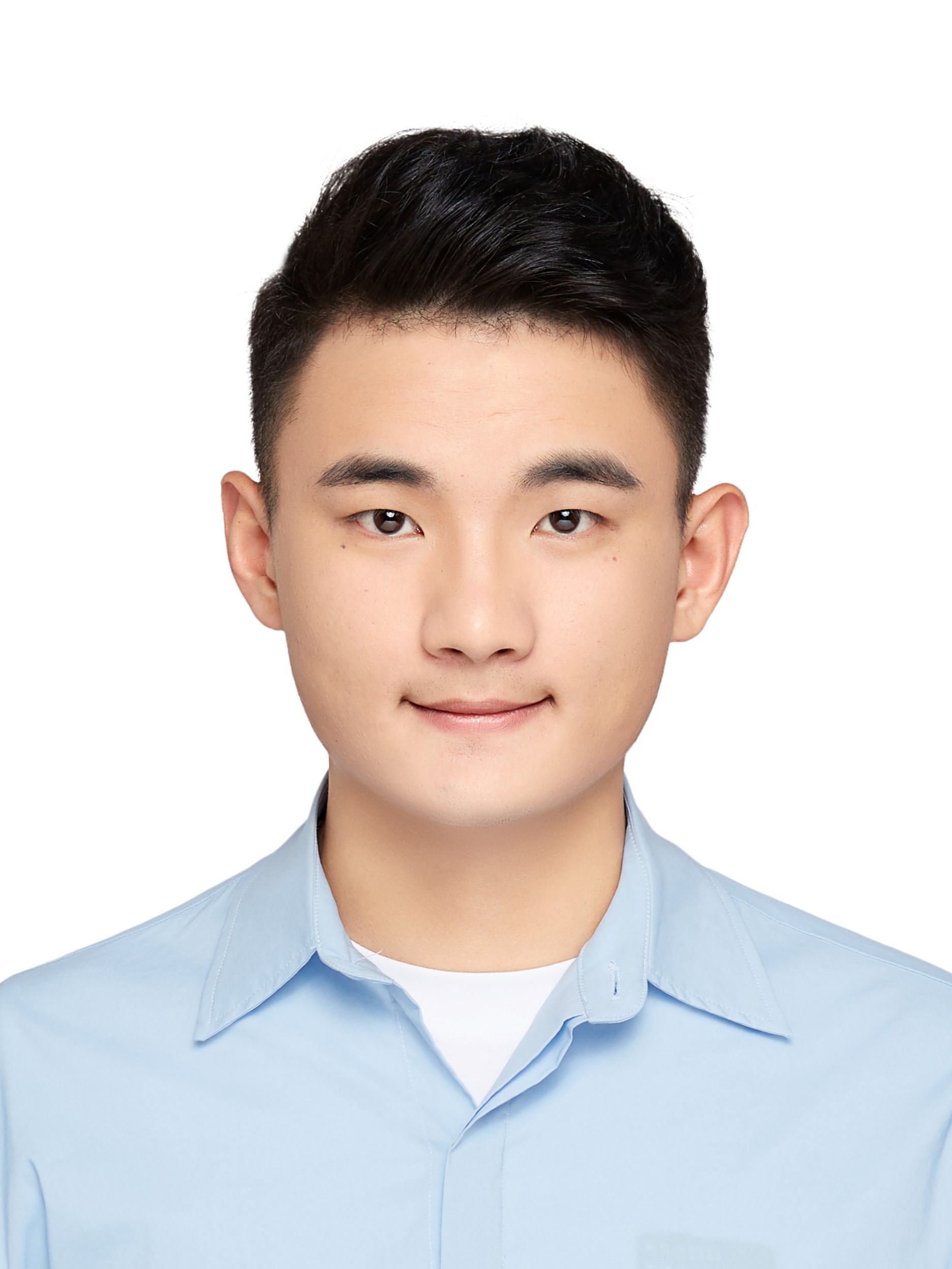
Welcome to my Homepage!
About Me
Hi! I am a second-year master’s student in the School of Computer Science at Shanghai Jiao Tong University.
Starting from 2024, I am supervised by Prof. Xiaokang Yang and Associate Professor Yichao Yan at the Institute of Artificial Intelligence. Prior to that, I received my bachelor’s degree from Shanghai University.
My research interests include Motion Generation, Personal Portrait Animation and Computer Vision. I am also interested in History in my spare time.
Feel free to reach out if you are interested in collaboration or potential opportunities.
News
- 2026.03 🎉🎉 One paper: SingingBot is accepted by ICME 2026!
- 2025.06 🎉🎉 One paper is accepted by ICCV 2025!
Publications
(* equal contribution · † corresponding author · ‡ project leader)
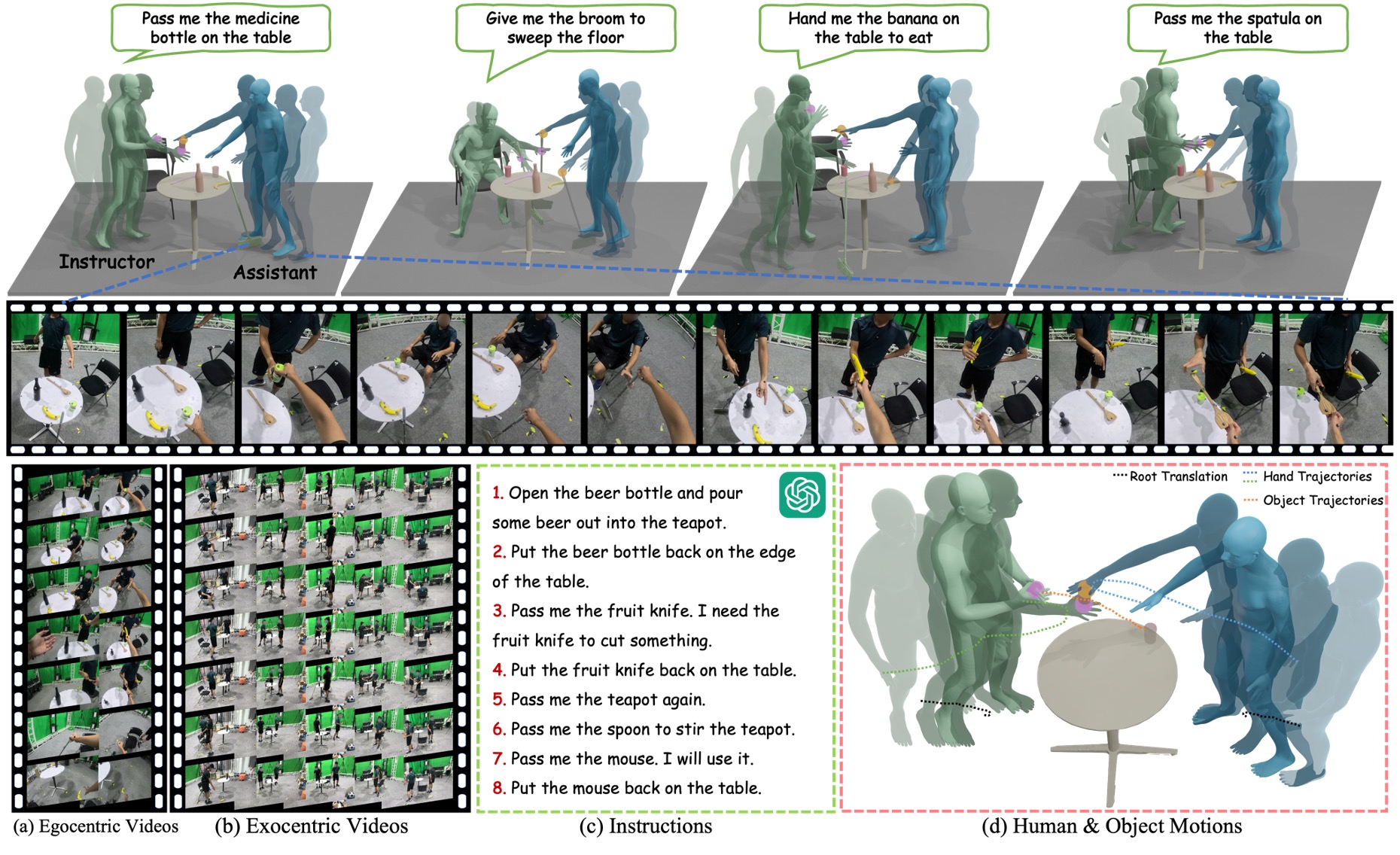
Perceiving and Acting in First-Person: A Dataset and Benchmark for Egocentric Human-Object-Human Interactions
Liang Xu, Chengqun Yang, Zili Lin, Fei Xu, Yifan Liu, Congsheng Xu, Yiyi Zhang, Jie Qin, Xingdong Sheng, Yunhui Liu, Xin Jin, Yichao Yan, Wenjun Zeng, Xiaokang Yang
We embed the manual-assisted task into a vision-language-action framework and build InterVLA, the first large-scale human-object-human interaction dataset with 11.4 hours and 1.2M frames of multimodal data, along with benchmarks on egocentric human motion estimation, interaction synthesis, and interaction prediction.
ICCV 2025 [arXiv]
Liang Xu, Chengqun Yang, Zili Lin, Fei Xu, Yifan Liu, Congsheng Xu, Yiyi Zhang, Jie Qin, Xingdong Sheng, Yunhui Liu, Xin Jin, Yichao Yan, Wenjun Zeng, Xiaokang Yang
We embed the manual-assisted task into a vision-language-action framework and build InterVLA, the first large-scale human-object-human interaction dataset with 11.4 hours and 1.2M frames of multimodal data, along with benchmarks on egocentric human motion estimation, interaction synthesis, and interaction prediction.
ICCV 2025 [arXiv]
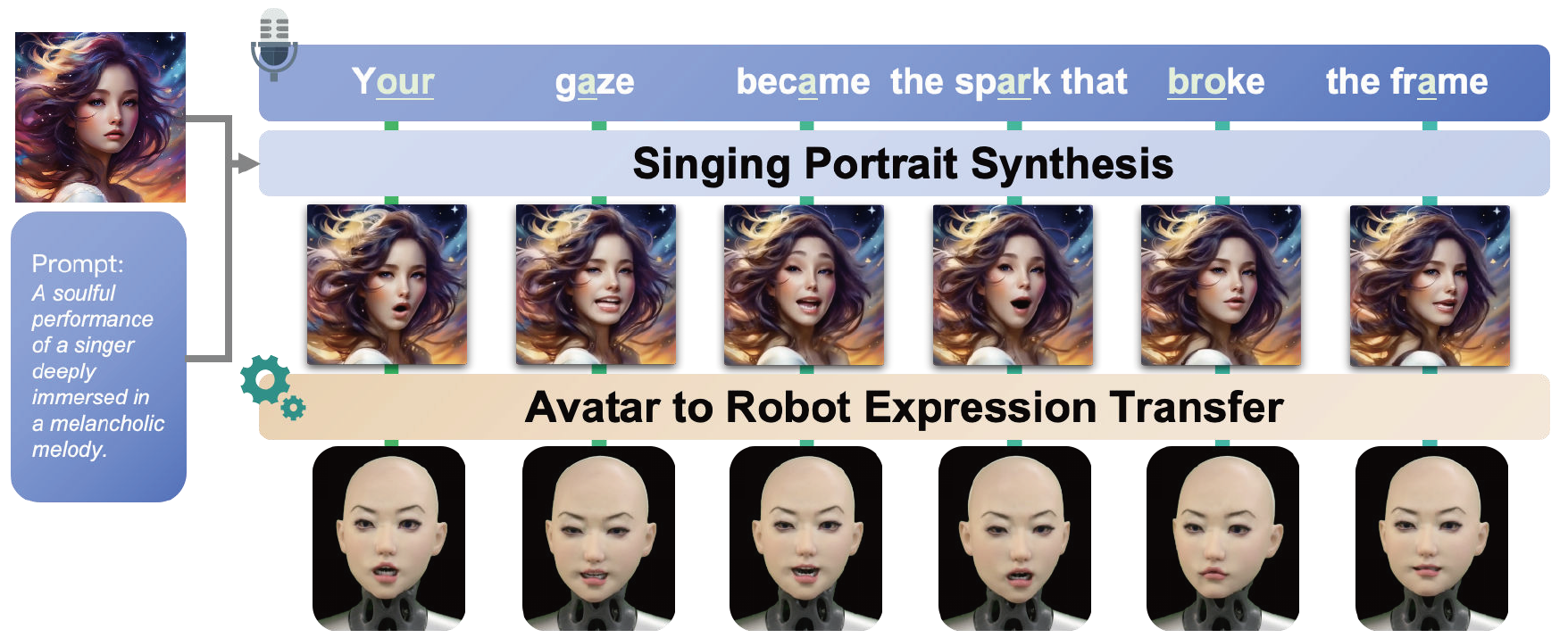
SingingBot: An Avatar-Driven System for Robotic Face Singing Performance
Zhuoxiong Xu, Xuanchen Li, Yuhao Cheng, Fei Xu, Yichao Yan, Xiaokang Yang
We propose an avatar-driven framework for appealing robotic singing that synthesizes vivid singing avatars for expression guidance and transfers facial features to the robot via semantic-oriented mapping, achieving rich emotional expressions while maintaining lip-audio synchronization.
ICME 2026 [arXiv]
Zhuoxiong Xu, Xuanchen Li, Yuhao Cheng, Fei Xu, Yichao Yan, Xiaokang Yang
We propose an avatar-driven framework for appealing robotic singing that synthesizes vivid singing avatars for expression guidance and transfers facial features to the robot via semantic-oriented mapping, achieving rich emotional expressions while maintaining lip-audio synchronization.
ICME 2026 [arXiv]
Honors and Awards
- Coming soon.
Educations

Shanghai Jiao Tong University
2024.09 - Present
M.S. student at School of Computer Science, advised by Xiaokang Yang and Yichao Yan
2024.09 - Present
M.S. student at School of Computer Science, advised by Xiaokang Yang and Yichao Yan

Shanghai University
B.E.
Received my bachelor's degree before joining SJTU
B.E.
Received my bachelor's degree before joining SJTU